
Carrom Shots: Types, Techniques and How to Play Them
Carrom shots are techniques players use to send carrom men toward the pockets with a striker. Different shots follow different paths depending on the position of the carrom man and the pocket.
Learning these techniques can help you make more accurate shots and handle different positions on the board with greater confidence. Knowing when to use each shot can also help you make better decisions instead of relying on power alone.
What Are Carrom Shots?
Carrom shots are the different ways a player uses the striker to send a carrom man toward a pocket. The result depends on the striker position, contact point, aim and amount of power used.
Some shots follow a direct path while others use the board to change the carrom man’s direction. Understanding these basic elements makes it easier to learn different shot types.
Types of Carrom Shots
Carrom shots differ mainly in the path used to move a carrom man toward a pocket. Some shots follow a direct route while others use the board to change direction or reach a target from a difficult position.
Straight Shots
A straight shot sends the carrom man directly toward the pocket without using the side of the board. It works best when the carrom man and pocket have a clear path between them.
Because there is no change of direction, the shot is easier to read than a rebound shot. The main challenge is keeping the striker lined up with the carrom man and using controlled force so the carrom man reaches the pocket cleanly.
Bank Shots
A bank shot sends the carrom man toward the side of the board before it travels toward the pocket. This creates a new path and can make a pocket possible when a direct route is not available.
The point where the carrom man meets the board has a major effect on its final direction. Players need to read the angle carefully and adjust the striking direction rather than relying on extra power.
Bounce and Rebound Shots
Bounce and rebound shots change the carrom man’s path after it strikes the board. They are useful when a direct route to the pocket is not available and the target needs to reach the pocket from another direction.
These shots can be harder to control because the carrom man changes direction after hitting the board. The player needs to judge the new path before striking.
Pocket and Corner Shots
Pocket shots are used to send a carrom man into a pocket from its current position. The best approach depends on the distance, angle and space around the target.
Corner shots are useful when a carrom man is near a corner or when the corner pocket is harder to reach directly. These shots require careful positioning because there is often less room for error.
Trick Shots in Carrom
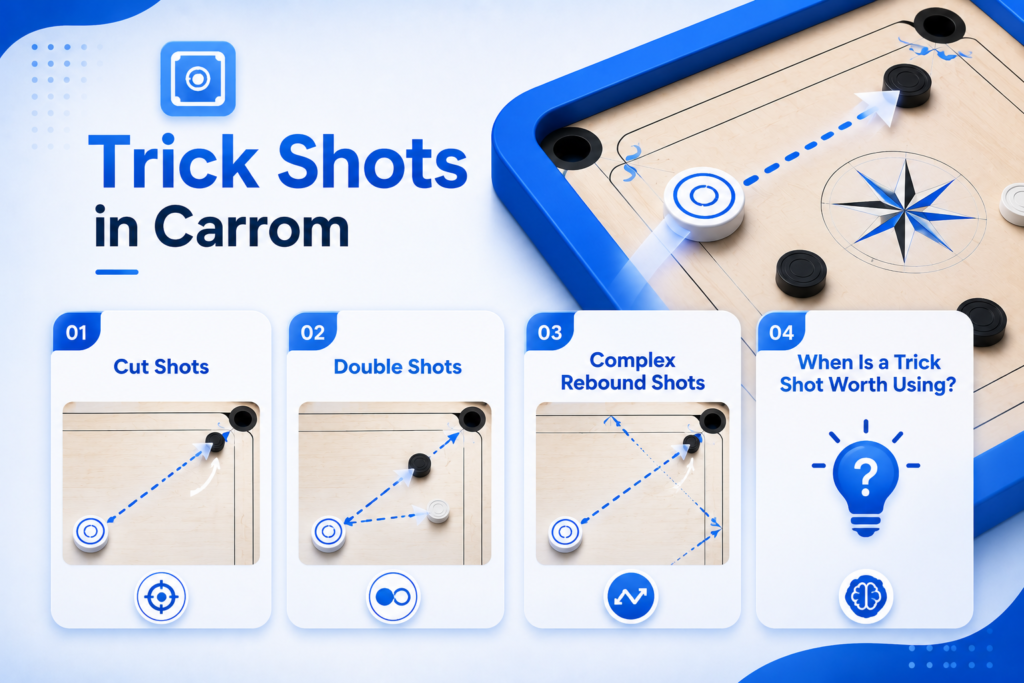
Trick shots are advanced techniques used when a normal route to the pocket is difficult or unavailable. They require careful planning because the carrom man may need to follow a less direct path.
Cut Shots
A cut shot sends the carrom man toward the pocket at an angle by hitting it from one side. It is useful when the carrom man is not lined up directly with the pocket.
The point where the striker hits the carrom man affects its direction. A small change in the contact point can change the path so controlled striking is important.
Double Shots
A double shot uses the movement of one carrom man to create an opportunity for another. It requires the player to consider the position and direction of both carrom men before striking.
The first movement needs to be controlled because it can affect the position of the second carrom man. If the first contact is slightly off, the follow-up shot can become harder to make.
Complex Rebound Shots
Complex rebound shots use more than one change of direction to reach a difficult target. They can be useful when a single rebound does not provide a workable path.
These shots require the player to plan the full route because each contact affects what happens next. The focus is on controlling the sequence rather than only aiming for the final pocket.
When Is a Trick Shot Worth Using?
A trick shot is worth considering when a simpler option does not provide a practical route to the target. It can also help when the position of the carrom men creates an opportunity that a normal shot cannot handle.
However, difficulty alone does not make a shot better. If an advanced technique has a low chance of success, a safer option may be more effective.
How to Play a Break Shot
A break shot is the opening strike used to start a game of carrom. Unlike a normal pocketing shot, its main purpose is to open the group of carrom men and create useful opportunities for the next part of the game.
Set Up the Striker
Place the striker where it has a clear path toward the group of carrom men. Its position can affect how the carrom men spread after contact.
Before striking, look at the arrangement and decide which area you want to open. This gives the break a clear purpose instead of making it a random hit.
Choose the Contact Area
Where the striker hits the group can influence how the carrom men spread across the board. A central contact may open the group differently from a strike aimed toward one side.
Choose the contact area based on the spread you want to create. This can help open a useful route or position carrom men for the next play.
Plan for the Next Shot
A good break is not only about spreading the carrom men. It should also create useful positions for the shots that may follow.
If the break opens a clear route or leaves a carrom man in a useful position, it can give you more options for the next play.
A Common Break Shot Mistake
A common mistake is trying to make the group spread as much as possible. A wide spread does not always make the next shot easier.
Instead, focus on where the carrom men end up after the break. A controlled spread can be more useful than a wide one.
Power and Accuracy: How to Make Better Shots
Power and accuracy work together when you want to make reliable carrom shots. More power does not always give a better result. The goal is to use enough force to reach the target while keeping the carrom man under control.
Control the Power
The amount of power needed depends on the distance and position of the carrom man. A nearby target usually needs less force, while a longer route may need more.
Using too much power can make the carrom man travel farther than you want or leave it in a difficult position afterward. Using the right amount of force helps keep the shot predictable and consistent.
Aim Before You Strike
Accuracy starts before the striker moves. Decide where you want the carrom man to go and picture the path it needs to follow.
Keep your aim steady while taking the shot. Changing your direction at the last moment can make even a well-planned shot harder to control.
Improve Shot Accuracy
Better accuracy comes from making small adjustments to your aim and power. Pay attention to where the carrom man goes compared with the path you intended.
Over time, these small adjustments can help you understand how changes in direction and force affect your shots.
Queen Shot and Queen Cover
The Queen is an important part of carrom because pocketing it alone does not normally secure it. The player also needs to complete the required cover and consider how the play affects the rest of the board.
How to Approach a Queen Shot
Before attempting the Queen, check its position and the available route to the pocket. Also look at the carrom men that could be used for the cover afterward.
A Queen attempt should be planned as a two-part play: first pocket the Queen, then complete the cover. Thinking about both parts before striking can help you avoid a situation where the Queen is pocketed but cannot be covered properly.
Why the Queen Cover Matters
Under standard carrom rules, pocketing the Queen does not normally secure it by itself. The player must cover the Queen according to the rules being used, usually by pocketing one of their own carrom men on the following play.
This makes the cover an important part of Queen play rather than something to consider only after pocketing the Queen. Planning the cover in advance can help you make a safer Queen attempt.
When to Go for the Queen
A Queen opportunity is more suitable when both the Queen shot and the required cover are reasonably achievable. If the Queen is easy to pocket but the available cover is difficult, attempting it may not be the best choice.
The decision should also take the remaining carrom men into account. Sometimes waiting for a better position can give you a clearer Queen-and-cover opportunity than taking a difficult shot immediately.
How to Choose the Right Carrom Shot
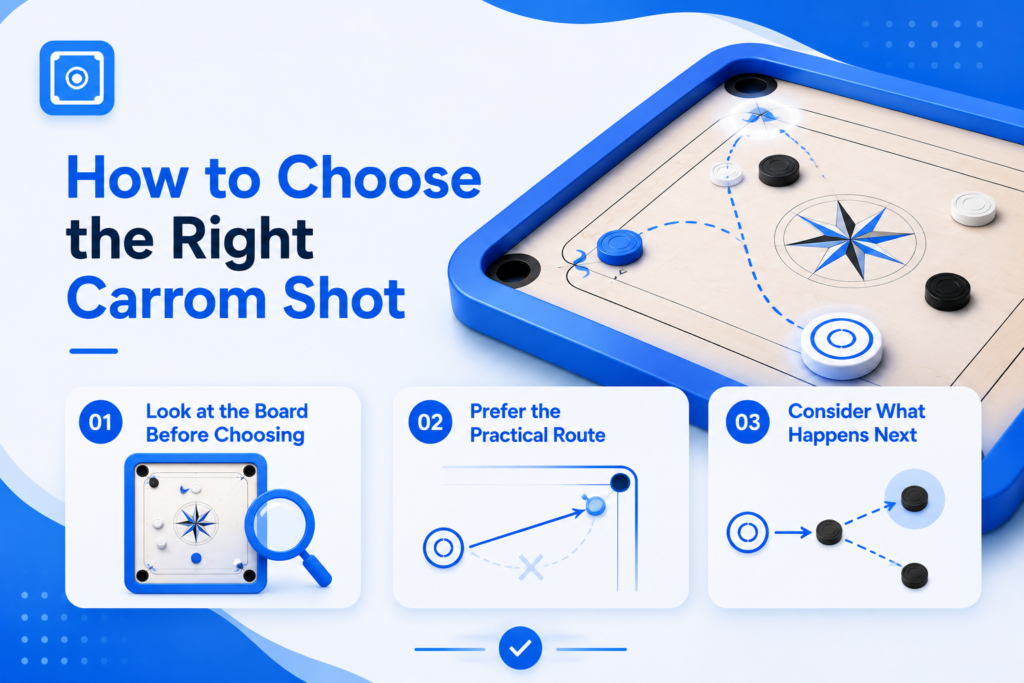
Choosing the right shot starts with the position of the carrom man and the route available to the pocket. The best option depends on the space, angle and other carrom men around the target.
| Board Situation | Shot to Consider | Main Focus |
| Clear path to the pocket | Straight shot | Direct route |
| Direct route is blocked | Bank or rebound shot | Board angle |
| Target has a difficult angle | Cut or trick shot | Precise direction |
| Opening play requires the group to be opened | Break shot | Board position |
| Queen has a practical route and cover option | Queen shot | Queen and cover |
| Target is close to a corner | Corner or angled shot | Available route |
The table is a guide rather than a fixed rule. Your choice may change depending on the board position and the options available at that moment.g on the board position and the options available at that moment.
Look at the Board Before Choosing
Start by checking the target, nearby carrom men, and available pockets. This helps you see which routes are open and which ones may make the shot unnecessarily difficult.
Do not choose a technique simply because you are comfortable with it. Let the board position guide your decision.
Prefer the Practical Route
When two or more shots can reach the same target, consider which one gives you a better chance of success. A simpler route can often be more useful than a difficult technique when both options can produce a similar result.
The practical choice can also reduce risk and leave more useful options for the next play.
Consider What Happens Next
A successful pocket is not the only result worth considering. Look at where the remaining carrom men and striker may end up after the shot.
Thinking one play ahead can help you avoid difficult positions and keep better options available. This makes shot selection about the overall board position, not just the current target.
Common Carrom Shot Mistakes and How to Fix Them
Even when you know different carrom techniques, small mistakes can affect the result. Fixing these common problems can help you make more controlled and consistent shots.
Using Too Much Power
A hard strike can send the carrom man too far or disturb nearby pieces. More force does not always make a shot better.
Fix: Use only the force needed for the distance and route. If the carrom man regularly goes too far, reduce the power slightly.
Poor Striker Alignment
If the striker is not lined up with the intended path, the carrom man may move away from the target.
Fix: Check the striker position before striking. Make sure it is aligned with the path you want the carrom man to follow.
Misjudging the Board Angle
Bank and rebound shots can fail when you focus only on the pocket and ignore where the carrom man will hit the board.
Fix: Check the full route before striking. Consider where the carrom man needs to meet the board and where it should go after the rebound.
Choosing a Difficult Shot Unnecessarily
A difficult technique is not always the better choice. If a simpler route can reach the target, choosing a harder shot may add unnecessary risk.
Fix: Compare the available routes before striking. Choose the simpler option when it gives you a good chance of success.
Focusing Only on the Current Pocket
A shot can succeed but still leave the board in a difficult position. Focusing only on the current target can make the next play harder.
Fix: Consider where the striker and remaining carrom men may finish. Choose a shot that leaves you with useful options when possible.
Going for the Queen Without a Cover Plan
Attempting the Queen without checking the cover can create unnecessary risk when the rules require the Queen to be covered.
Fix: Check the cover option before attempting the Queen. If it is difficult, waiting for a better opportunity may be safer.
How to Practice Carrom Shots
Good practice is not just about taking the same shot again and again. Focus on different distances, angles, and board positions so you can learn how each situation affects the shot.
Start With a Clear Target
Choose one type of shot or board situation for a practice session. Repeat the same setup several times before changing the position or distance.
This makes it easier to see what works and what needs improvement.
Practice Different Angles
Do more than straight shots. Practice cut, bank and rebound shots from different positions to become comfortable with changing routes.
As these shots become easier, use more difficult angles and positions.
Test Different Levels of Power
Practice the same route with different amounts of force. Try shorter and longer distances to learn how much power each situation needs.
The goal is to understand how distance and force work together rather than relying on one fixed level of power.
Learn From Missed Shots
When you miss, look at what happened before trying again. Notice whether the carrom man went too far, fell short or moved away from the intended path.
Then change one thing and try again. This makes it easier to find what caused the miss.
Increase the Difficulty Gradually
Once a shot becomes more reliable, make the setup harder by changing its angle, distance or starting position.
Later, combine different board positions to make practice closer to a real game.
Frequently Asked Questions About Carrom Shots
These common questions cover practical ways to learn, practice and improve carrom shots.
What is the easiest carrom shot to learn first?
A straight shot is usually the easiest place to start because the carrom man has a direct path to the pocket. It also helps you learn basic aim and force control before trying more difficult shots.
How long does it take to improve carrom shot accuracy?
There is no fixed time because progress depends on how often you practice and how well you learn from each attempt. Regular practice with different distances and angles can help you improve your control over time.
Should beginners focus on accuracy or power first in carrom?
Beginners should focus on accuracy first. Once you can control the direction and basic force of a shot, you can gradually work on stronger shots.
How can I practice carrom shots without an opponent?
You can practice alone by setting up different carrom man positions and repeating specific shots. Start with simple routes and gradually add angles, rebounds and more difficult positions.
Why do I keep missing carrom shots even when my aim looks correct?
The problem may be the striker position, contact point, angle or amount of force. Change one factor at a time and observe the result to find what is affecting the shot.
Final Thoughts
Good carrom play is not about making every shot powerful or choosing the most difficult technique. It comes from reading the board, understanding your options and giving each shot a clear purpose.
Focus on control, learn from your results, and choose the option that gives you the best chance of success. With regular practice, you can improve your aim, handle different board positions and make better decisions during a game.
In carrom, a well-planned shot is often more valuable than a flashy one.


One Comment